Words as a second language of politics
Three collections, published in London and New York between 1905 and 1917, made Sarojini Naidu one of the most widely read Indian poets writing in English. This section reads the work — its technique, its subjects, its reception and its argument.
Ornament — drawn for this site
What the poems are made of
English forms, Indian streets
Her best-known poems take an ordinary occupation and turn it into a song with a fixed refrain. Bearers carrying a bride in a palanquin. Weavers at a loom at dawn, at evening, at night. Fishermen putting out from the Coromandel coast. Sellers calling their goods in a Hyderabad bazaar.
The technique is consistent: a short line, an insistent rhythm, heavy use of colour words, and a structure borrowed from English lyric and folk song. The material is entirely Indian — the trades, the objects, the festivals, the flowers, the weather.
That combination is what made the poems travel. It is also what made them contested. To some readers they are a genuine act of literary self-assertion: Indian life given the dignity of formal English verse at a moment when English literary culture rarely granted it. To others they are decorative, and shaped too closely to what a London readership of 1905 expected India to look like.
What do you sell, O ye merchants?
From ‘In the Bazaars of Hyderabad’, The Bird of Time, 1912 — public domain
Richly your wares are displayed.
Rise, brothers, rise; the wakening skies pray to the morning light,
Opening line of ‘Coromandel Fishers’, The Golden Threshold, 1905 — public domain
The collections
Three books, twelve years, one argument
-
1905
The Golden Threshold
Published in London with an introduction by Arthur Symons. The collection that established her English reputation and contains most of the poems still anthologised in Indian schoolbooks — ‘Palanquin Bearers’, ‘Indian Weavers’, ‘Coromandel Fishers’. The title later became the name of her house in Hyderabad, and the house later became an institution.
-
1912
The Bird of Time
Songs of Life, Death & the Spring, published in London and New York with an introduction by Edmund Gosse. The tone darkens. Alongside the folk-song poems sit pieces on grief, mortality and religious devotion — among them ‘In the Bazaars of Hyderabad’ and ‘The Soul’s Prayer’. Gosse used the preface to describe the advice he had given her years earlier, which makes the book, in part, a public answer to it.
-
1917
The Broken Wing
Songs of Love, Death and Destiny. The most explicitly political of the three, published in the year of the franchise deputation. It contains ‘The Gift of India’, written in the voice of India addressing the imperial powers about the Indian soldiers who died in the First World War, and ‘Awake!’, addressed to Muhammad Ali Jinnah — with whom she was then working on Hindu–Muslim political unity.
-
Later
Collected and posthumous
The Sceptred Flute: Songs of India gathered her work for an American readership in 1928. The Feather of the Dawn appeared in 1961, twelve years after her death, edited by her daughter Padmaja Naidu. After 1917 she published no new collection in her lifetime; the years that followed went to politics.
Ornament, not archive
The imagery of the poems, drawn as ornament
The three drawings below are decorative artwork made for this website, taking their subjects from recurring images in her verse. They are not historical material and are not presented as such. Every archival photograph on this site carries a plate number and a caption.
Ornament — after ‘Indian Weavers’
Ornament — after ‘The Bangle Sellers’
Ornament — after ‘Coromandel Fishers’
Reading the work
Five ways into the poems
Her language
She wrote in the register of late-Victorian English lyric — inversions, apostrophes, a high vocabulary — and applied it without irony to Indian subjects. Read today, that register sounds ornate. Read against 1905, it is the sound of claiming a literary tradition rather than being admitted to it on sufferance.
Her imagery
Colour, textile and trade dominate: silk, saffron, henna, silver, glass bangles, grain, spice, the river, the bazaar. The imagery is deliberately material. Her India is made of objects that people make and sell, which is an unusual emphasis for a poet so often described as merely lyrical.
Her themes
Love, death, devotion, seasonal change, and work. In the later books, national feeling and communal unity join them directly. ‘The Gift of India’ is a war poem written from the position of a colonised country that has supplied soldiers to an empire — a position English war poetry of the same years does not occupy.
Her Indian landscapes
The geography is specific: Hyderabad’s bazaars, the Coromandel coast, the rivers and gardens of the Deccan, Kashmir. She writes places she knew rather than a generalised Orient, and the poems are usually anchored to a trade or a ritual that belongs to that place.
Her literary legacy
She remains among the most taught Indian poets in English. Later Indian poets in English — writing after 1947, in a plainer idiom — have often defined themselves against her manner. That is a form of influence too. Critical opinion has moved several times since 1949, and continues to move.
A caution
Everything in this column is interpretation, offered as such. The verifiable facts are narrower: what she published, when, with whom, and how it was received at the time. Where this site states a critical judgement it says so, and does not dress it as record.
Circulation
The poet became a picture
Long before independence, Sarojini Naidu’s likeness was being printed and sold in India as a popular image — on cards, in colour lithographs, in the kind of print that hung in shops and homes.
That circulation is part of the literary story, not separate from it. A poet whose face is sold in a bazaar has a different kind of public authority from one who is only read. When she spoke at a Congress session or a women’s conference, a substantial part of the audience already recognised her.
It also began the process this site returns to on the Legacy page: the conversion of a complicated political figure into a simple, warm and quotable one.
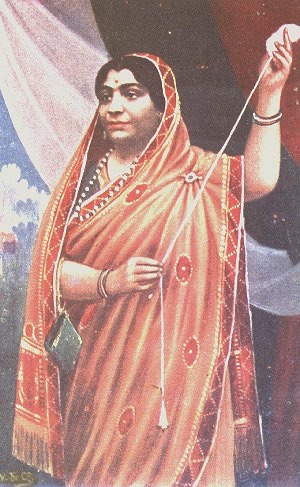
A popular printed image rather than a photograph. Prints of this kind were widely produced in early twentieth-century India and are evidence of public standing, not of appearance.