From movement to governance
On 15 August 1947 Sarojini Naidu was sworn in as Governor of the United Provinces. She had spent nearly thirty years opposing the authority that office represented. Making that transition — from resistance to constitutional responsibility — was the last work of her life.
The office
- Title
- Governor of the United Provinces
- Sworn in
- 15 August 1947
- Held until
- 2 March 1949 — she died in office
- First
- The first woman to hold a governorship in India
1946 – 1947
Two rooms before the Government House
Her last two years as a private citizen were spent in the work of constructing a state.
In 1946 she was elected to the Constituent Assembly, representing Bihar — the body that drafted the Constitution of India. Records of the Assembly show her intervening only rarely in debate; she was by then in visibly declining health.
In March and April 1947, months before independence, she presided over the Asian Relations Conference in New Delhi. Convened by the Indian Council of World Affairs and held from 23 March to 2 April, it drew delegates from across Asia to discuss what relations between newly independent Asian countries might look like. The closing session was held at the Purana Qila before a very large audience.
It is an unusual credential for a poet: chairing the first substantial pan-Asian political gathering of the decolonising era, four months before her own country became independent.
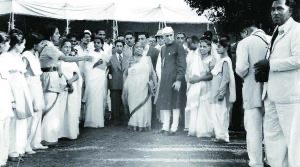
A small, low-resolution archival print. It is shown at its natural size and proportion rather than enlarged.
What she inherited
The United Provinces, August 1947
The transition was not ceremonial. She took office in a large, populous northern province in the weeks of partition.
The name
The province was called the United Provinces throughout her tenure. It was renamed Uttar Pradesh in 1950, a year after her death. Descriptions of her as “Governor of Uttar Pradesh” are therefore an anachronism, though a very common one.
The office itself
Under the interim arrangements and then the Constitution, a governor is the constitutional head of a province or state, acting on the advice of an elected ministry. It is not an executive office in the ordinary sense. Its power is largely formal, and its influence largely moral — which suited what she had to offer.
Partition
Independence came with the partition of British India and one of the largest forced migrations in recorded history. Northern India saw enormous movements of people, widespread communal violence and severe pressure on food, shelter and public order. This was the condition of the province she was appointed to represent.
What she brought to it
Communal unity had been one of her constant public arguments since at least 1917. A governor who had spent thirty years making that case in public, and who was recognised by sight across the country, was useful in a province where public reassurance was in short supply. Appeals for calm and for the protection of minorities were a substantial part of her public role.
The harder question
Opposition is not the same skill as office
The passage from anti-colonial movement to constitutional government is usually told as a triumph. For the people who made it, it was a genuine difficulty.
A movement is built to refuse: to withhold co-operation, break unjust laws, and accept the consequences. A government must do the opposite — enforce laws, hold order, take responsibility for outcomes, and answer for failures that are now its own. The people who did the first thing well were not automatically equipped for the second, and several of them said so.
Sarojini Naidu occupied a peculiar version of that problem. The governorship of a province was the precise office through which British authority had been exercised over her. She now held it, on behalf of an independent India, in a province in crisis, at the age of sixty-eight and in poor health.
She held it for less than nineteen months.

The original print is cropped close at the top edge. It is reproduced here exactly as it survives, without further cropping.
2 March 1949
Government House, Lucknow
She died in office at Government House, Lucknow, on 2 March 1949, of cardiac arrest. She was seventy. Her last rites were performed at the Gomti river.
She had been a public figure for close to half a century: a published poet at twenty-six, a Congress president at forty-six, a prisoner at sixty-three, a governor at sixty-eight. She saw independence and governed under it for nineteen months. She did not live to see the Constitution she had been elected to help frame come into force, in January 1950, nor the first general election under adult suffrage in 1951–52.
Her daughter Padmaja Naidu went on to serve as Governor of West Bengal from 1956 to 1967, and edited the posthumous collection of her mother’s verse.